
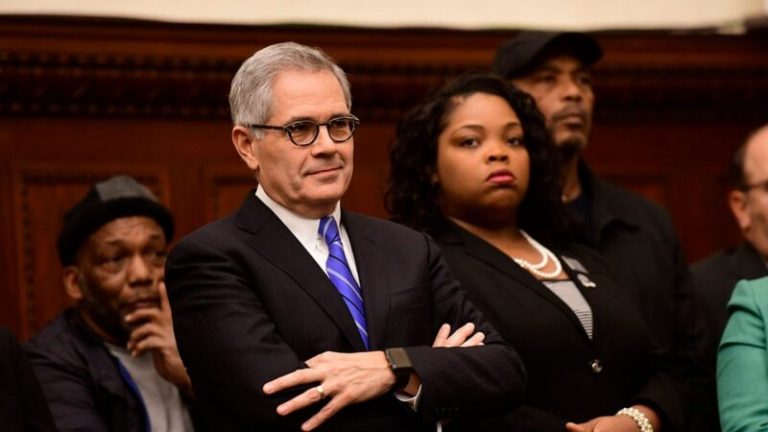
Philadelphia County District Attorney Lawrence Krasner criticized the Trump administration for dispatching ICE agents to airports to assist TSA officers who have gone unpaid for weeks amid a Democrat-forced funding lapse at the Department of Homeland Security.
Krasner, a Democrat whose campaigns received funds tied to left-wing Hungarian-American billionaire George Soros, has criticized President Donald Trump and DHS for months over their immigration enforcement measures and previously threatened to “hunt down” ICE agents he believed violated city laws if there were to be a Minnesota-style situation in Pennsylvania.
On Tuesday, Krasner spoke from the airport, saying Trump administration officials have tried to confound the public and agents themselves as to what is legal behavior and what is not.
Krasner said he will not accept any phone calls from President Donald Trump asking for leniency:
IGNORED ICE DETAINERS ‘PUT LIVES AT RISK,’ DHS SAYS, TARGETING NEWSOM, PRITZKER, HEALEY
“The president cannot pardon you and yes I will put you in handcuffs, and I will put you into a courtroom, and if necessary, I will you put you a jail cell if you decide to make the terrazzo floor of this airport anything like what you did in the streets of Minneapolis,” Krasner said, addressing agents.
He claimed that situation involved “the criminal homicide of unarmed, innocent people” and that Philadelphia would not accept such actions.
“My job is to enforce the law: so this is how that works — because I know there have been efforts to confuse you, including by the Vice President of the United States. This is how it works. You commit crimes within the jurisdiction that is the city and county of Philadelphia, I prosecute you.”
Vice President JD Vance declined to comment. But, the White House lambasted separate comments from Krasner as he stood in front of a “Wooder Ice” mural for a video message.
Backed by ominous music, Krasner said Philadelphians enjoy Water Ice because it “doesn’t break the law [nor] bother us at an airport.” The “Rapid Response 47” team called Krasner’s video “sick and deranged,” adding, “If you don’t like it, Larry, tell your fellow Democrats to fund DHS.”
Krasner also noted during his airport remarks that there are law-abiding agents within DHS ranks.
FETTERMAN SLAMS DEMOCRATIC ‘MESS’ AS TSA WORKERS MISS PAYCHECKS DURING DHS SHUTDOWN
“I have a message for the good people, and there are a lot of good people [in] ICE… Keep your oath. Uphold the United States Constitution. Uphold the laws. It does not matter whether I personally approve of policies that you are following,” Krasner began, adding he believes DHS’ “mass deportations” are “immoral.”
“To any agent who might think of doing in an illegal way, I’ll be seeing you in court and you’re not going to like it because a Philly jury is not going like what you did if it is illegal.”
When a reporter appeared to mention that the city cannot instruct ICE agents, Krasner said he is not suggesting Immigration and Naturalization Services (INS) agents or ICE should not be present in Philadelphia, but that there appears to be “sort of an escalation” in the novel concept of using ICE to do the work of TSA.
DEMOCRATS BROKE AIRPORT SECURITY. NOW THEY’RE CALLING THE SOLUTION DANGEROUS
Krasner claimed ICE’s presence at airports and elsewhere has given foreigners cold feet.
He said the city saw 2,000 hotel rooms canceled for FIFA’s World Cup in June, and that he heard from Scottish fans that they would stay home because of high gas prices, airline ticket prices and the idea that their brogue could make them a target for ICE.
“There are Scottish soccer fans who do not want to come here for fear their accent will be overheard and they’re going to get a bunch of grief from ICE agents in the airports, which they’ve never experienced before. This is a direct economic hit to FIFA and all the cities where it applies. This is a direct economic hit to the city of Philadelphia.”
“It is just one more thing that this president is doing to basically wreck our economy. I wish he wouldn’t do it. Having said that, I cannot blame an ICE agent who is following orders, has come here and is standing in the corner, basically doing nothing,” he said, calling ICE’s work as TSA agents “stupid but lawful.”
Krasner’s comments come as other top Democrats have lambasted ICE’s presence in airports, including remarks from one senator who claimed people will die because of them.
“ICE agents at airports will only aggravate delays & lines — disrupting checks, interrogating travelers, dragging parents from children, detaining citizens, brutalizing families, shooting & even killing,” Connecticut Sen. Richard Blumenthal wrote on X.
“Brutal, lawless tactics common in communities across the country by masked, unidentified agents, violating basic rights — no way to help TSA or travelers,” he continued.
House Minority Leader Hakeem Jeffries of New York added separately that the last thing “the American people need is for untrained ICE agents to be deployed at airports all across the country, potentially to brutalize or in some instances kill them.”
“We have already seen how ICE conducts itself,” Jeffries continued. “These are untrained individuals when it comes to doing the current job they have, for the most part, let alone deploying them in close proximity in highly sensitive situations at airports across the country,” the East New York lawmaker added.
Fox News Digital reached out to DHS for comment.
Fox News Digital’s Elaine Mallon contributed to this report.